Category: Maker In Residence

  • Forging the Future with Right to Sound Projects

    Forging the Future with Right to Sound Projects

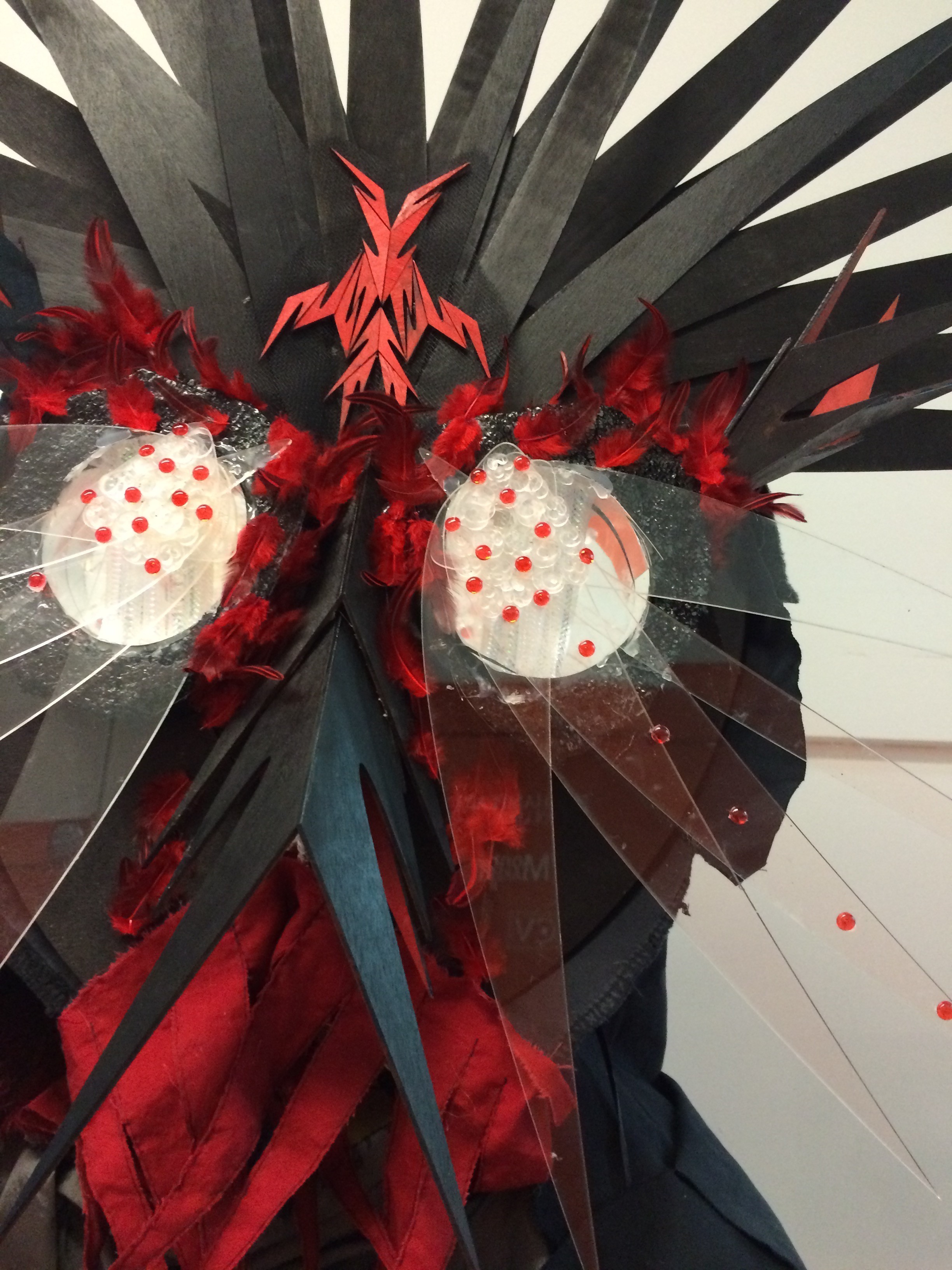
    [vc_row type=”in_container” full_screen_row_position=”middle” scene_position=”center” text_color=”dark” text_align=”left” overlay_strength=”0.3″][vc_column column_padding=”no-extra-padding” column_padding_position=”all” background_color_opacity=”1″ background_hover_color_opacity=”1″ width=”1/1″ tablet_text_alignment=”default” phone_text_alignment=”default”][image_with_animation image_url=”5221″ alignment=”” animation=”Fade In” box_shadow=”none” max_width=”100%”][/vc_column][/vc_row][vc_row type=”in_container” full_screen_row_position=”middle” scene_position=”center” text_color=”dark” text_align=”left” overlay_strength=”0.3″][vc_column column_padding=”no-extra-padding” column_padding_position=”all” background_color_opacity=”1″ background_hover_color_opacity=”1″ width=”1/1″ tablet_text_alignment=”default” phone_text_alignment=”default”][heading]Forging the Future with Right to Sound Projects [/heading][/vc_column][/vc_row][vc_row type=”in_container” full_screen_row_position=”middle” scene_position=”center” text_color=”dark” text_align=”left” overlay_strength=”0.3″][vc_column column_padding=”no-extra-padding” column_padding_position=”all” background_color_opacity=”1″ background_hover_color_opacity=”1″ width=”1/1″ tablet_text_alignment=”default” phone_text_alignment=”default”][vc_column_text]In 2015, with their first residency at Generator, Devin Alejandro-Wilder began the Right to Sound Projects, an ongoing series of audiovisual installations that address the massive lapse of support that people with disabilities face in the context of our current healthcare systems. Two years later, in November 2017, they returned as a second-time resident with new problems regarding the functionality of their newly obtained prosthetic. Upon receiving the BAHA 5 (Bone Anchored Hearing Aid), Alejandro-Wilder realized that the side effects they had been experiencing with the device that they had paid 5000 dollars out of pocket for, were largely due to basic design flaws. In the spirit of maker-culture, they then decided to sidestep the engineers at Cochlear by using cutting-edge Rapid Prototyping 3d scan and print technology as well as Generator’s multi-tiered system of designers and fabricators to build modifications that would not only solve these problems but improve functionality.

    Two months later, with this support, they were able to design a 3d printed model of a functional case for the prosthetic, as well as a conceptual design for an industrial version that would incorporate Teflon and rubber light resin all while doing independent scholarly research and public outreach to find ways to speak out on these issues. It is their hope that in releasing these designs and advancing their involvement with local organizations for people with disabilities as a community scholar, that that they will be able to use their knowledge of healthcare legislature and reform to push public discourse on these issues so that pertinent changes in political policy will occur.[/vc_column_text][/vc_column][/vc_row][vc_row type=”in_container” full_screen_row_position=”middle” scene_position=”center” text_color=”dark” text_align=”left” overlay_strength=”0.3″][vc_column column_padding=”no-extra-padding” column_padding_position=”all” background_color_opacity=”1″ background_hover_color_opacity=”1″ width=”1/1″ tablet_text_alignment=”default” phone_text_alignment=”default”][nectar_btn size=”small” open_new_tab=”true” button_style=”regular” button_color_2=”Accent-Color” icon_family=”none” url=”https://www.devinalejandrowilder.com/” text=”Devin Alejandro Wilder”][/vc_column][/vc_row]
  • Meet Alex Constatino: August/September 2017 Maker-in-Residence

    Meet Alex Constatino: August/September 2017 Maker-in-Residence

    [vc_row type=”in_container” full_screen_row_position=”middle” scene_position=”center” text_color=”dark” text_align=”left” overlay_strength=”0.3″][vc_column column_padding=”no-extra-padding” column_padding_position=”all” background_color_opacity=”1″ background_hover_color_opacity=”1″ width=”1/1″ tablet_text_alignment=”default” phone_text_alignment=”default”][vc_column_text]

    Meet Alex Constatino

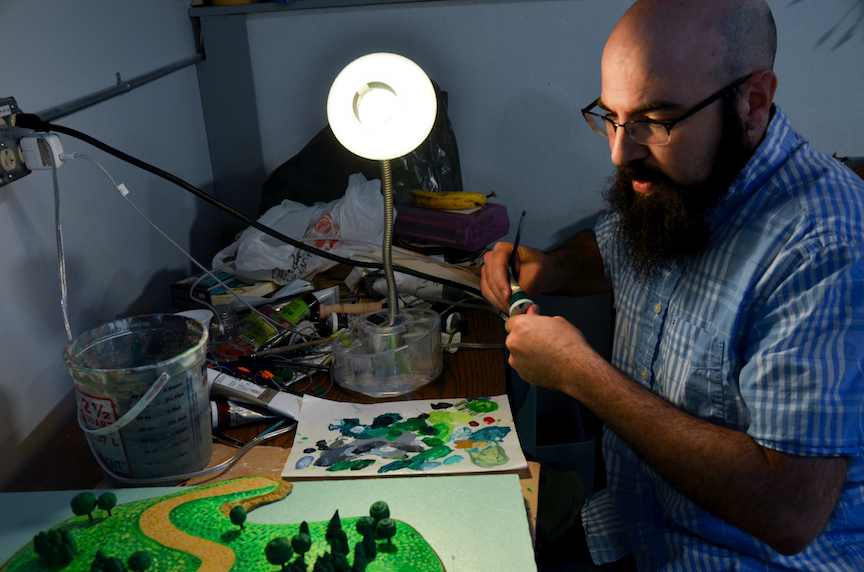
    Early this summer, I had an idea to create a very small town on an island in a lake somewhere in rural Vermont. My inspirations were not only my experience of parts of the Northeast Kingdom, but also of other less-populated parts of Vermont, such as the farming town where I teach in Franklin County. At the time, I was first thinking of it as a series of paintings or drawings, but as I tried to think through it, I found that my imagination was running into challenges, and that it was best to try to create the town first in three dimensions. I decided the best way to see the project through would be to create it, to scale, as a sculpture/set, and I knew I couldn’t do that on my own, with my limited resources. This is why I applied for the Maker in Residency at Generator.


    Artistically, I’m a painter, a printmaker, a sculptor, a potter, and even a sometimes animator and photographer. It’s important that each medium be valued on its own terms, but I am much less bound to any particular medium than I am to the ideas that the medium lives in. My transition from the painting and previous work to the high-tech approach to sculpture and set design I’ve been pursuing through my residency has more to do with determining the best methods to translate my ideas into fruition. The residency at Generator enabled me to learn to use 3D scanning, 3D modeling, and other aspects of computer aided design to use tools I had previously felt out of reach- 3D printing, 4 axis milling, and CNC routing.


    My basic plan for my residency was to create an environment that could be used for photographic, video, and other projects as a preexisting world based on a mythical version of Vermont, with its beautiful environment, its relative isolation, and the push and pull between self-sufficiency and dependence on the outside world. My residency was the first step on a multi-step process to create and establish the island of Avalon. Over my residency, I designed and built two major landforms of the islands, and build all the structures and flora on the smaller island. The landforms were created from 3D scans of plasticine models I created and then scaled up. I CNC cut foam panels that I then laminated, finished, and painted. Most of the structures and trees were 3D printed from models I designed in CAD/CAM software. I set these all into a backdrop painted in acrylic on canvas using methods and techniques I brought from my previous painting work. In the future, I will be developing richer and larger backdrops, building more landforms, and filling them with structures, flora, and other components using techniques I learned over my residency and equipment and tools from Generator.

    [/vc_column_text][/vc_column][/vc_row][vc_row type=”in_container” full_screen_row_position=”middle” scene_position=”center” text_color=”dark” text_align=”left” overlay_strength=”0.3″][vc_column column_padding=”no-extra-padding” column_padding_position=”all” background_color_opacity=”1″ background_hover_color_opacity=”1″ width=”1/2″ tablet_text_alignment=”default” phone_text_alignment=”default”][image_with_animation alignment=”” animation=”Fade In” box_shadow=”none” max_width=”100%”][/vc_column][vc_column column_padding=”no-extra-padding” column_padding_position=”all” background_color_opacity=”1″ background_hover_color_opacity=”1″ width=”1/2″ tablet_text_alignment=”default” phone_text_alignment=”default”][image_with_animation alignment=”” animation=”Fade In” box_shadow=”none” max_width=”100%”][/vc_column][/vc_row]

  • Meet Edward Burke: Maker-in-Residence Jan/Feb 2017

    Meet Edward Burke: Maker-in-Residence Jan/Feb 2017

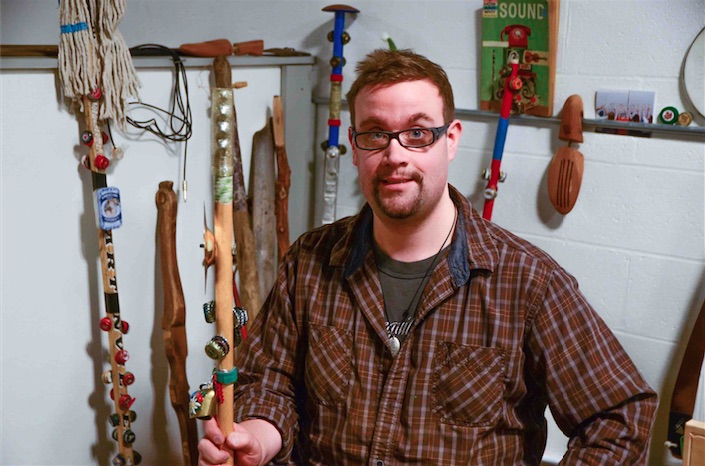
    Lagerphones
    Lagerphones by Jan/Feb Maker in Residence Edward Burke.

    Meet Edward Burke, Generator’s January/February 2017 Maker-in-Residence.  It’s not hard to spot him whittling his stumpf fiddles in his studio at Generator.

    I have always been fascinated with the idea of building and playing my own instruments – instruments that were portable, easy to learn and play, and ones which would let me make a variety of interesting sounds, while making me stand out in a crowd with unique looks; instruments that elicit the question of “What IS that thing, man”? or “What do you call that”?

    With the power of YouTube and his bedroom as a studio,  he started crafting his own DIY stumpf fiddles. Stumpf fiddles and similar instrument go by different names like the lagerphones, which are played in Australia, stumpf fiddles, which are played in Germany, and ugly sticks, played in Newfoundland, Canada. If you see a kind of walking stick with a rubber ball at the bottom and a bell, horn, woodblock, springs and a tin pan drum — that’s a stumpf fiddle! In order for Edward to make his own, he had to collect odds and ends like old broom handles, screen door spring, antique pie plates, bike bell, bike horn, wood block, bottle caps, etc.  Upcycle to the extreme!

    I had no blueprints; only the videos I saw from YouTube to go on. It was rough, and primitive, and my first attempt was not put together well, but then a visit to my Dad in the summer of 2016 gave me the necessary “oomph” I needed to finish the instrument. His help and suggestions proved invaluable to me, and sparked my curiosity and enthusiasm for wanting to build more instruments, and hone my woodworking/simple hardware skills. My Dad’s help was similar to the kind of personable suggestions, constructive criticism, and technical advice you get from volunteers and staff members here at the Generator.

    Through the residency, Edward seeks to make great strides in his craft of making unique sounds.  These instruments are ideal for empowering street artists to share in a truly unique way.  Edward came to the opinion after college that the best and most poignant music was made not by a classically-trained musician on the most expensive instrument; it was music which was made on the simplest instruments and sung from the mouths of people who have a variety of stories to tell, be they good, bad, uplifting, or funny, that was always the best, most inspiring music.

    An overall belief and mantra leading me in my projects is this: Music is communal, and is conversation, is collaboration, is inspiration. To use a cliche, Less is more. And to quote the late, great Frank Zappa: “I am not a virtuoso. Virtuosos can play anything.  I can’t”. This is the spirit in which I hope to finish out my residency, and give a final performance to the Generator community. I’ve got some wierd lyrics I’ve been writing up that just BEG to be accompanied by my mad-cap hooligan arsenal of noise-bringers”.

    Come join Edward in his performance at the next Generator Member meeting on Monday, March 13th at 5:30pm!

  • Zach Harmon: Maker-in-Residence August/September 2016

    I often hear that the sole purpose of drums is to keep a steady beat for the band. I disagree. I began playing piano at age 3 and switched to the drum set at age 15. Ever since making the switch, one of my main pursuits has been to apply the melodic and harmonic sensibilities of the piano to the drum set. Despite years of exploring the melodic potential of instruments such as tabla, congas, and batá, I was still dissatisfied with the melodies I was able to create on drum set. Until now.

    -Zach Harmon

    Zach Harmon started his residency in August and got connected with Gregory Givens to help with the engineering challenges in his pursuit for an elite and unique drum. Zach designed a drum set that combined the physical act of drumming with the piano’s ability to create chords and melodies.  The foot pedals have been altered to be electronic control mechanisms. By pressing the foot pedals while striking the instrument, the performer can alter the pitch of each drum.

    The design borrows from many fields of technology, some being outside Zach’s expertise. With the help of the Generator community, he was able to create a prototype.


    There will also be an interface for programming tuning presets: pressing a button on this interface will automatically reposition the mechanisms in the drums to a higher or lower range of pitch, which will greatly expand the melodic capability. In addition to being a valuable teaching tool for ear-training, composition, and intonation, this instrument will enable drummers to be heard as more than just timekeepers—as equals in harmonic accompaniment. Melodic soloists. Leaders.

    -Zach Harmon

  • Iona Fox: Resident of June/July 2016

    Iona Fox: Resident of June/July 2016

    Iona Fox

    Meet Iona Fox: Generator June/July 2016 Maker in Residence


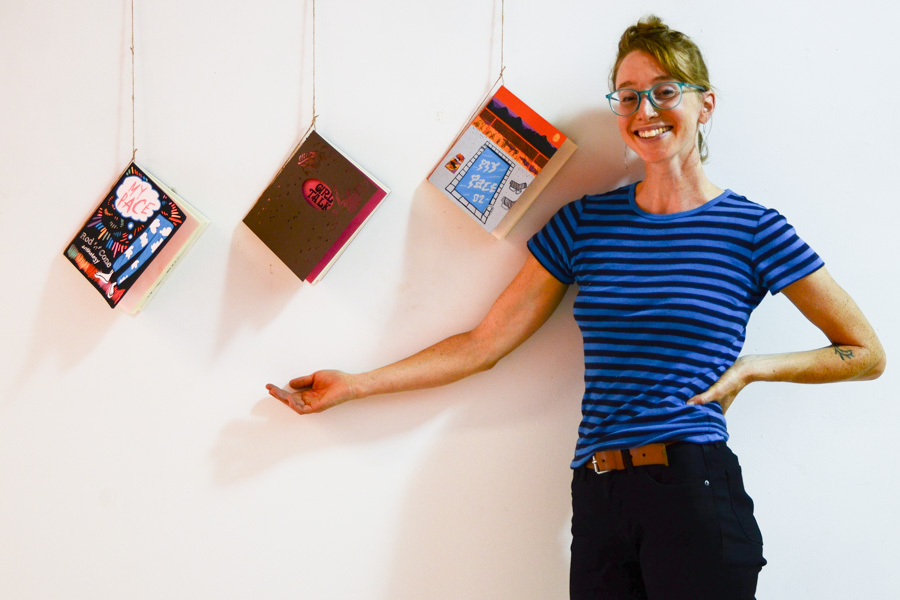
    Iona Fox heard about the Maker-in-Residency through her partner Rob Rock, one of Generator’s long term members and farm tool inventor. Her endeavor to learn how to use the laser cutter was geared towards bringing a new dimension to her book covers; by end of two months she had three well crafted specimens.

    I think I will use the laser a lot more in the future!

                                                                 -Iona Fox

    Iona has established forward momentum and is finding her work well in demand. Post her residency, she starts a comic strip for Seven Days in September 2016. One of her big challenges is scaling up and how to keep books stocked.  Iona is confident that the solution can be found through the collective knowledge shared at Generator.

    After getting to know the characters at Generator, you have a better sense of who you can ask to help you with each challenge.

                                                                 -Iona Fox

    She has her eyes set on printing a solid run on a new book.

    It would be nice to do it here(at Generator). I might make the equipment that I need,

    which is only possible with time and help from members.

                                                                 -Iona Fox
    The Maker-in-Residence Program supplied the time and space that Iona needed. Having the ability to come and go in and out of focus on her work without stress was key to her success.  

  • Athena Kafantaris: Resident of February/March 2016

    Athena Kafantaris: Resident of February/March 2016

    Athena Kafantaris is a Burlington-based artist, performer and puppeteer currently working on massive, performer-operated dolls and puppets. She uses primarily recycled materials, including found and personal objects, to build creatures and environments. At her core, she is a collage artist and has great interest in integrating mediums like installation, sculpture, video and performance. Themes explored in her work are loss, the family structure, communication and metamorphosis. Watch her documentary style interview…IMG_3566

    What you sought to accomplish during your time of residency? 
    
    I chose to focus on four areas of development for my ongoing puppet 
    project. My goals were to develop a rotating collar assembly for 
    performance, experiment with extending puppet limbs, develop costume 
    pieces that integrate various textures and to develop portable power and 
    lighting systems for performance pieces. I developed a new puppet with 
    onboard lighting and power, made various costume pieces, developed a first 
    draft of the USB fan collar design, and experimented with a new 
    articulated puppet hand design. I also started using a projector to play 
    with the concept of projection as costume, an area I have been interested 
    in exploring for a while.
    
    How you accomplished it?/An overview of what you learned.
    
    I was able to advance all these goals, primarily using the laser cutter, 
    3D printer and the electronics area. In addition, I took the machine shop 
    and CNC classes to develop a better understanding of machining. I learned 
    new software, including Blender, Inkscape, Illustrator and Fritzing, and 
    these helped me greatly to understand modeling and layout as they relate 
    to axis-based devices. I also spent a lot of time working on prototyping, 
    especially for the more complicated goals like extending limbs and the 
    rotating collar.
    
    
    How did the generator community participate in your experience?
    
    I got so many wonderful and challenging ideas from Generator members and 
    used several concepts pitched at the members meeting where I initially 
    presented. Devin had suggested playing with lighting acrylic and I heavily 
    experimented with this concept. Robin suggested casting with silicone, 
    which I have not tried yet, but am in the process of exploring. Pete 
    encouraged me to explore inflatable parts for costume and puppets and I'm 
    excited to do more research on using that concept. Max was incredibly 
    helpful with all of my goals, taking the time to carefully consider my 
    designs and suggest materials and techniques to achieve better results. I 
    couldn't have asked for a better teacher! Lastly, the biggest resource 
    from the community was Leif Hunneman, who encouraged me to apply for the 
    residency, taught me to solder, design printed circuit boards and finalize 
    a solution for power and lighting in my puppets. At every turn, members 
    offered to help and support my project any way they could. People were so 
    open to sharing their own process and to working out possible solutions. 
    I'm so grateful that I had access to such generous minds.
  • Devin Wilder: Resident of December/January 2016

    Devin Wilder: Resident of December/January 2016

    Meet Devin Wilder

    dacd0ec9-ced1-4042-b3dc-3d6aea7ce8c8

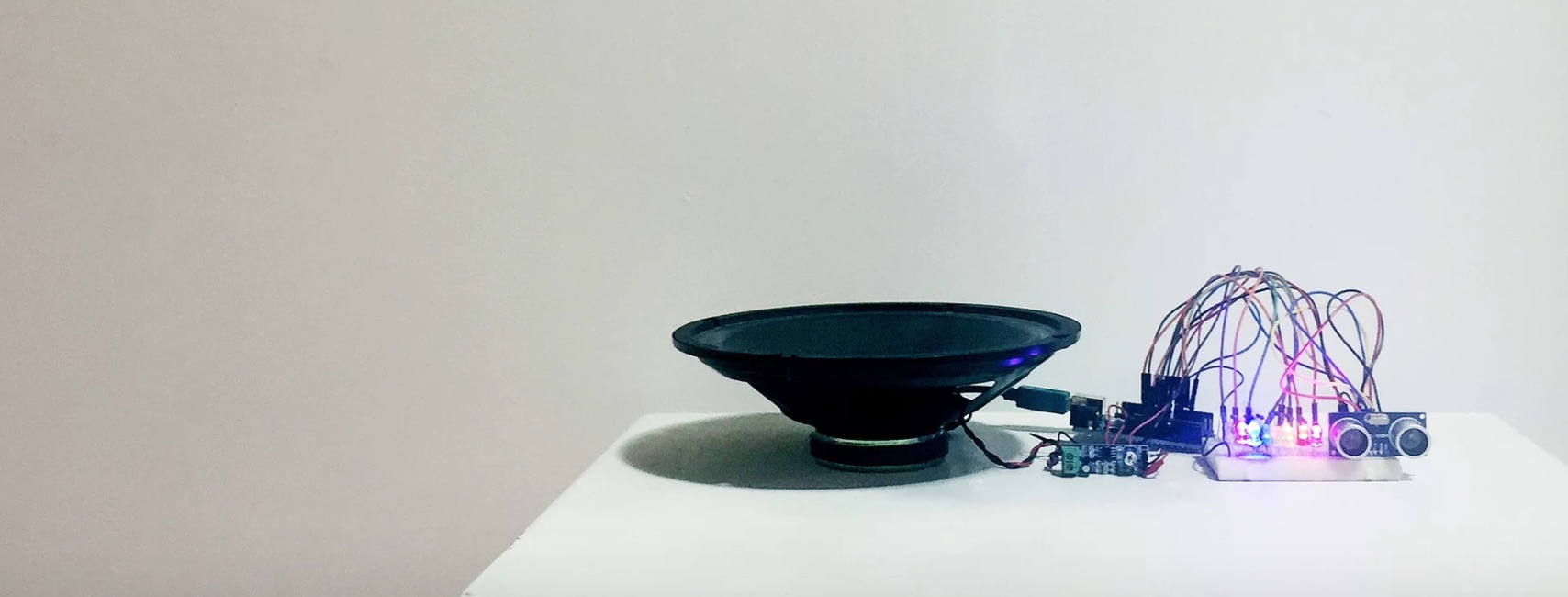
    Devin‘s work is with Cymatics, where one can use vibration and frequency in conjunction with specifically engineered apparatuses to reintroduce sound as a visual experience. During her residency, she will use Generator’s resources to construct her own Cymatic models.

    In addition to working on these experiments, performances, and demonstrations, she will also use her time as resident to jumpstart “The Right to Sound Project”, a social justice movement that uses art and technology to raise awareness about the hearing impaired community and the fact that insurance companies do not assist in covering the cost of any hearing aids, regardless of the severity of one’s disability.

  • Tina Escaja: Resident of September/October 2015

    Tina Escaja: Resident of September/October 2015

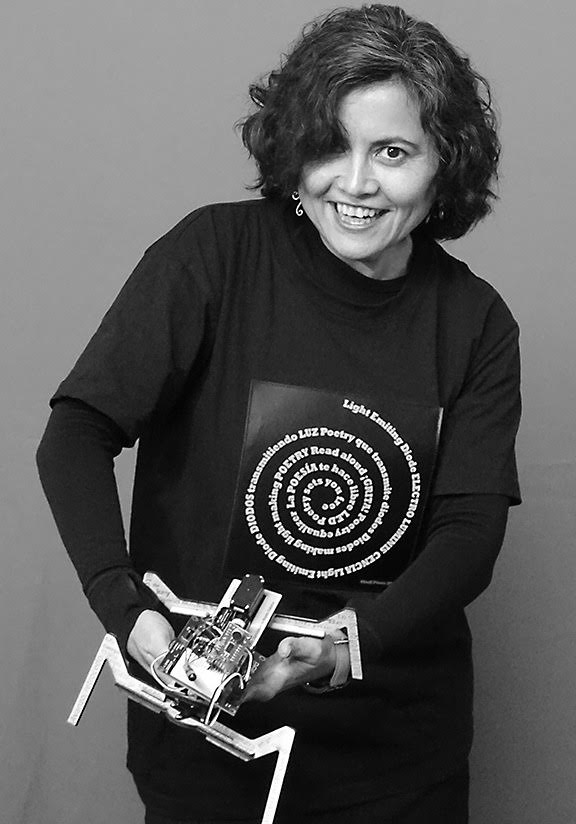
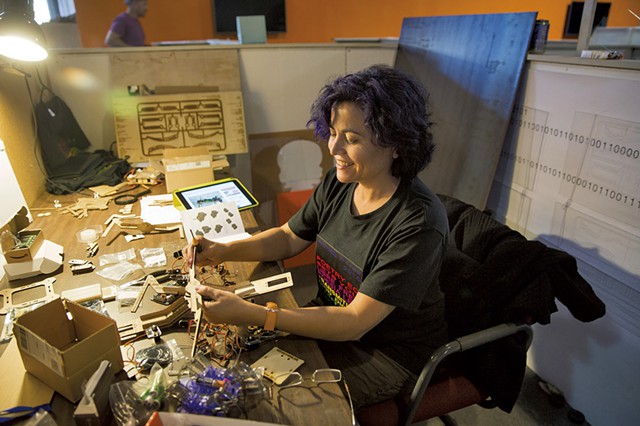
    Tina Escaja joins us from the University of Vermont Department of Romance Languages and Linguistics where she is a Professor of Spanish with special expertise in digital media and poetry. During her two month residency at Generator, Tina used 3D design tools, the laser cutter and 3D printer and other resources while tapping member hands and minds to produce poetry robots, autonomous performance entities with a penchant for prose.

    unnamed

    As maker-in-residence at Generator my goal was to create robopoems, that is, poetry-inflected/engraved robots that would move and interact with humans and with each other. Generator provided me with the space, connections and resources to accomplish this ambitious goal. I chose insect-like designs found in online open-sources to emphasize anxiety and removal from humans while underlining the already problematic relation between humans and technology. In fact, the original poem is expressed from the robot’s point of view and refers to existential issues, questioning binary definitions such as creature/creator, etc.

    My original poem, written in bilingual format (original Spanish with English translation by Kristin Dykstra) is composed of seven distinctive parts. I decided to divide the seven parts of the poem among five quadrupeds of similar size but belonging to three different models, to create a diversity of movements and poetic expression. I engraved the body parts with the lines of the poem and cut them primarily by using the laser-printer, my main tool at Generator. I decided to use plywood instead of my original idea of 3D printing, mainly to emphasize the aforementioned questioning of assumptions in the relation of humans with technology by using an organic material rather than plastic or metal. The laser was also an easier tool with which to tackle the project.

    I learned a lot about every single step of the process, starting with Adobe Illustrator (to create the wording to be engraved on the robot-parts); the laser printer! (my constant tool, which took me a long, long time to understand and use properly); assembling of robots (some of them extremely complex and puzzle-like); electronics (arduino, codes, sensors,…); etc. My vocabulary and learning skills improved exponentially during my residency with all these servos, restaring, vectoring, source coding, etc. … A whole new poetic dimension for sure.

    The whole Generator community was very supportive. Some members were particularly helpful and patient with me and my constant requests, such as Pete Talbot, who helped me a lot with Adobe Illustrator and with the use of the laser printer, always with a broad smile and a thoughtful, understanding spirit. Other members I have to credit for their support are Alex Costantino, Matt Hogan, Jacob Rothenbeck, Eric Cooper, Heather Hayes and many others who allowed me to keep progressing with my project. I also relied on friends and helpers outside Generator, particularly for electronics (Wesley Alan Wright) and for building one of the robots (Didier Delmas).

    In summary, Generator allowed me to bring to life my vision of robot-poems or “Robopoem@s” (“robopoemas” in Spanish), a vision otherwise unattainable in the form that I intended. Simply being in the physical space of Generator was, by itself, a wonderful experience and routine, as an opportunity to engage on regular basis with a visionary group of creators.  Certainly a privilege, and I am very grateful for the chance to spend two months as maker-in-residence at Generator.

    -Tina Escaja

    artsnews1-1-9d1f2d6db1a74cb6Screen Shot 2015-09-02 at 2.14.05 PM


  • Pete Talbot: Resident of January/February 2015

    Pete Talbot: Resident of January/February 2015

    Pete Talbot, Maker in Residence – Cardboard Products

    January/February, 2015

    11954626_10206002349590271_151440555140570671_n  

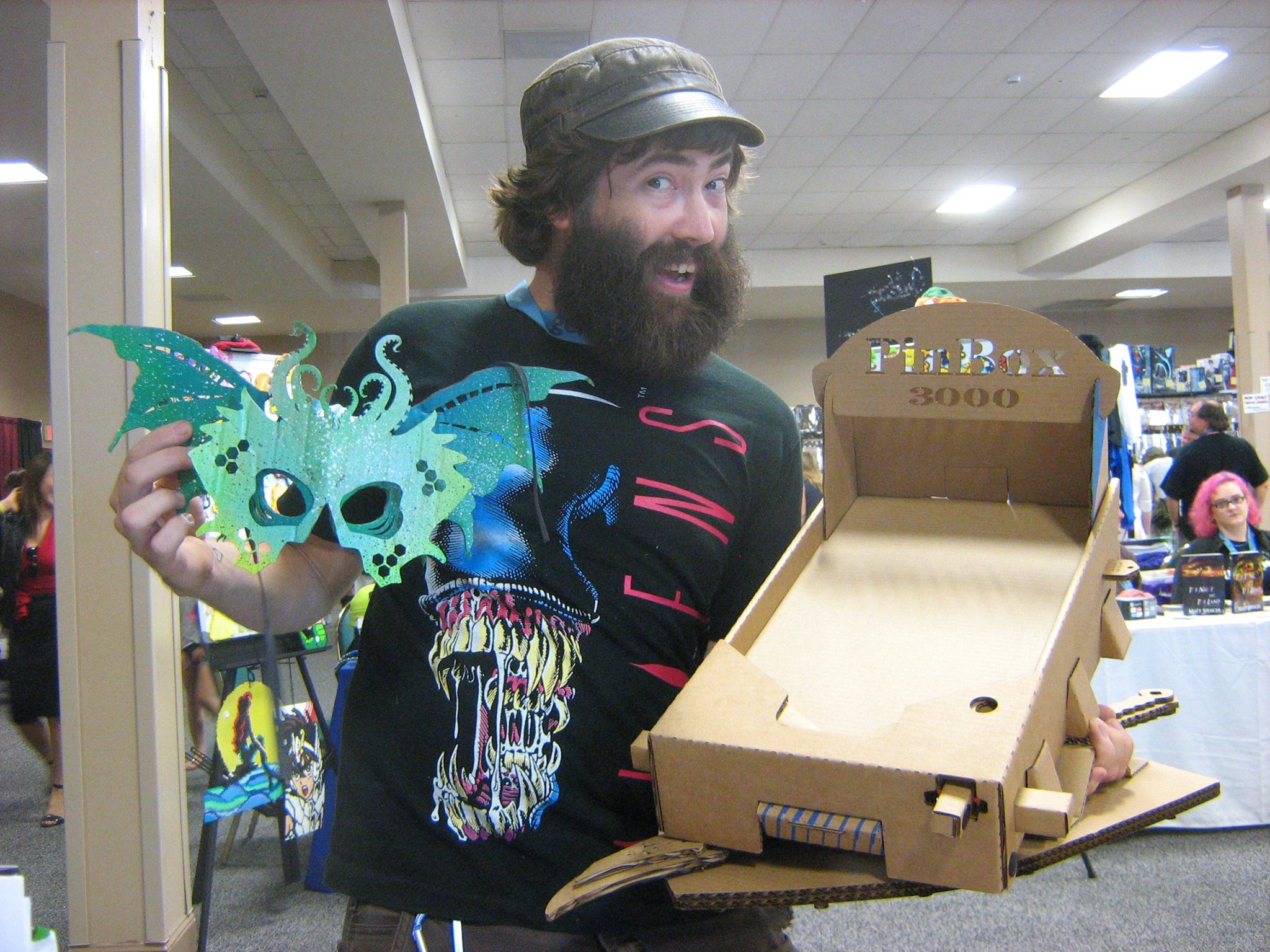
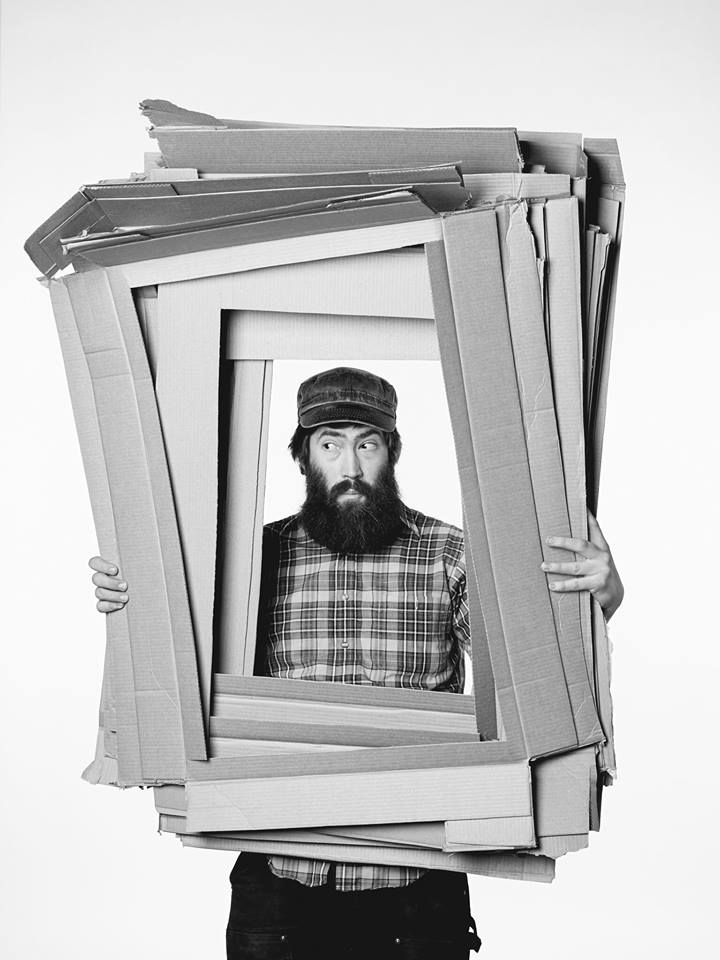
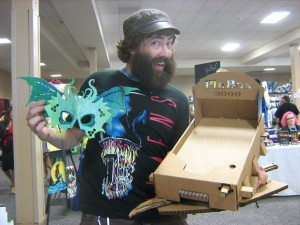
    Before Pete Talbot had joined Generator as a maker in residence, he was fully submersed in the laborious craft culture of hand fabricating cardboard arcades called Grottoblaster. Pete got a small taste of the magic of laser cutting which brought him to Generator.  His idea to create a cardboard pinball machine that would serve as a platform for fun, creativity, and learning grew into a larger social and manufacturing project than initially imagined. By the time he finished his residency, Peter became an expert Adobe Illustrator and laser cutter user. He not only had a working prototype but the beginnings of a whole new line of product and educational services.

    11999603_10207522234204537_3411570336565370213_o


    “Generator’s community was helpful for bouncing ideas off of people.  The members come from a wide array of backgrounds and skill sets; someone always has good advice about a process or how to problem solve. Generator helped me to save money and to be smarter”.

    -Pete Talbot


    Pete and Ben’s cardboard pinball machines and other creations keep gaining more traction so be looking out for their next debut or invention!

  • Courtney Reckord: Resident of March/April 2015

    Courtney Reckord: Resident of March/April 2015

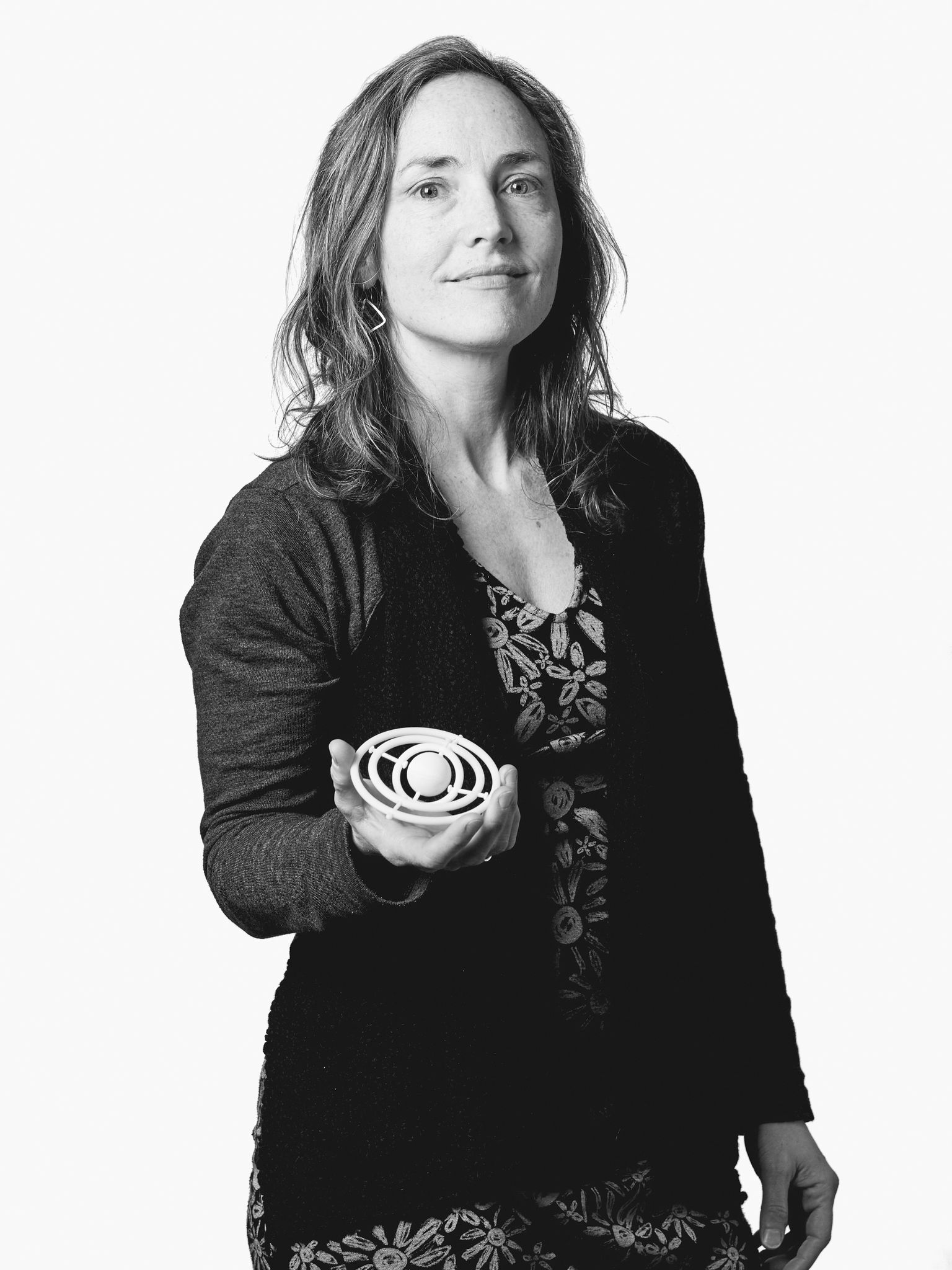
    Courtney Reckord (Mar/Apr) is a middle school art teacher with deep interests in technology integration. Courney was interested in finding new ways to apply topographical mapping to casting processes through 3D printing to be used in her jewelry designs. With a proof of concept now in hand, she is pushing this new approach to jewelry design into space (celestial topographies that is!).

    IMG_2153 (1)

    I reached out to Generator for the equipment to create 3d printed items, but more importantly the dedicated time in order to focus on my project. I spent a lot of time during my residency learning how to use Rhino, a 3 D modeling program, and then printing and revising my prototypes.I learned that I can teach myself a lot! I also was a little nervous going into the residency and doing a presentation for the members, but I realized that everyone was nothing but supportive and helpful. One specific challenge I faced during my residency was that learning how to do 3d modeling was very difficult, and since I was modeling using real data that was very complex, it was not something I could just look up the answer to. The problem solving was very intense, and there were many times when I was about to give up. However, if I made a slight bit of progress, I could continue. It is helpful having the Generator community there to support you through crucial moments.